Solar Panel Calculator: The Smartest First Step of Invest
Solar Panel Calculator: The Smartest First Step of Invest
Thinking about going solar? Before you call an installer or compare panel prices, there is one tool that can save you from the two most expensive mistakes in solar: buying a system that is too big for your needs, or too small to actually cut your bill. That tool is a solar panel calculator.
A solar panel calculator is a free online tool that takes your electricity usage, location, and roof details, and turns them into a clear answer: how many panels you need, what size inverter and battery bank fits, what the system will cost, and — most importantly — how much money it will save you over 10 to 25 years.
In this guide, we explain how these calculators work, walk through each major component they analyze, and show you how to use one purely for savings analysis before making any commitment.
What Is a Solar Panel Calculator?
A solar panel calculator is an estimation tool that models your future solar system on paper (or on screen) before you buy anything. You enter a few simple inputs:
- Your average monthly electricity bill or units consumed (kWh)
- Your city or location (this determines sunlight hours)
- Your roof space and orientation
- Whether you want battery backup or a grid-tied system
The calculator then applies real-world formulas — peak sun hours, panel wattage, system losses, and local electricity tariffs — to produce an output: recommended system size in kilowatts, number of panels, estimated cost, monthly savings, and payback period.
The best calculators go further and model your savings year by year, factoring in rising electricity prices and gradual panel degradation (panels typically lose about 0.5% efficiency per year). That is what turns a rough guess into a genuine financial analysis.
How the Calculation Actually Works
The core math is simpler than most people expect. Suppose your home consumes 600 kWh per month and your city receives an average of 5 peak sun hours per day.
- Daily need: 600 kWh ÷ 30 days = 20 kWh per day
- Raw system size: 20 kWh ÷ 5 sun hours = 4 kW
- Adjust for losses: Real systems lose 15–20% to heat, wiring, dust, and inverter conversion, so 4 kW ÷ 0.80 = 5 kW system
- Number of panels: 5,000 W ÷ 550 W per panel = 9–10 panels
A calculator does this instantly, and then layers on the financial side: system cost, monthly bill reduction, net metering credits, and the year your savings overtake your investment.
The Three Components Every Calculator Analyzes
1. Solar Panels
Panels are the largest visible part of the system and usually 40–50% of the total cost. A calculator helps you compare panel wattages — for example, whether ten 550W panels or twelve 450W panels better fit your roof and budget. It also checks whether your available roof area can physically hold the recommended number of panels, since a typical 550W panel needs roughly 25 square feet.
2. Solar Inverter
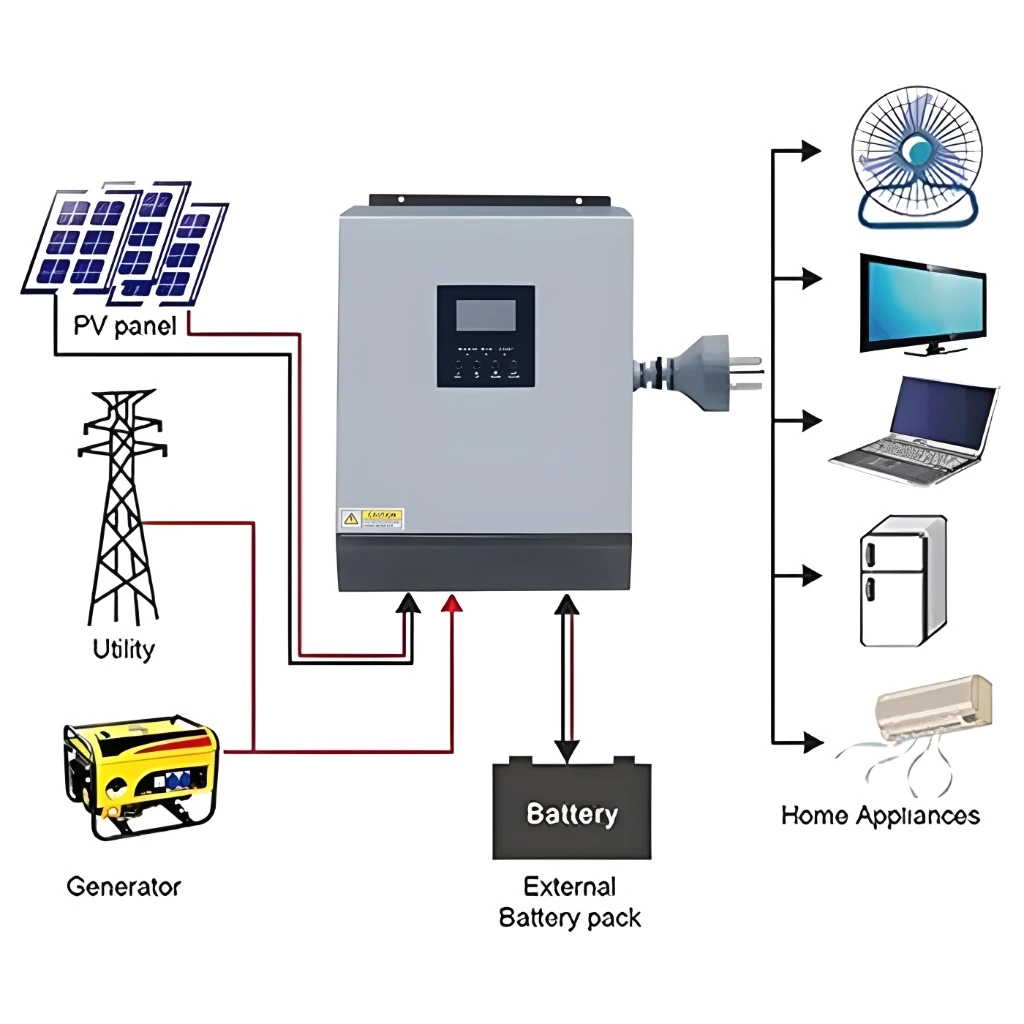
[IMAGE 2: Wall-mounted solar inverter — alt text: “Hybrid solar inverter converting DC power to AC for home use”]
The inverter converts the DC electricity your panels produce into the AC electricity your home uses. It is the brain of the system, and sizing it wrong is a common and costly error. A good calculator matches inverter capacity to your panel array — typically an inverter rated at 80–100% of your total panel wattage — and accounts for the 3–5% conversion loss in its savings math. It will also help you choose between a standard grid-tied inverter (cheaper, no backup) and a hybrid inverter (supports batteries and gives backup during outages).
3. Batteries
[IMAGE 3: Lithium solar battery bank — alt text: “Lithium battery storage bank for solar backup power”]
Batteries are optional but transformative — and expensive. They can add 30–60% to your total system cost. This is exactly where a calculator earns its keep for savings analysis. It answers the key question: do batteries actually pay for themselves in your situation?
If your area has frequent load-shedding or power cuts, batteries provide backup value beyond pure savings. If your grid is stable and net metering is available, the calculator will often show that exporting surplus power to the grid beats storing it. Seeing that comparison in numbers, before you spend, is invaluable.

7 Benefits of Using a Solar Panel Calculator
1. Prevents oversizing and undersizing. An oversized system wastes capital on capacity you never use; an undersized one leaves you still paying large bills. The calculator finds the right size the first time.
2. Gives you a realistic savings forecast. Instead of a salesman’s promise, you get math: monthly savings, annual savings, and a 25-year projection based on your actual usage and tariff.
3. Reveals your payback period. Most residential systems pay for themselves in 3–6 years depending on local electricity prices. The calculator shows your specific number, so you know exactly when your system starts generating pure profit.
4. Lets you compare scenarios instantly. With battery vs. without battery. 5 kW vs. 7 kW. On-grid vs. hybrid. Running these comparisons manually would take hours; a calculator does it in seconds.
5. Arms you for negotiations with installers. When you already know your required system size and fair market cost, you can immediately spot inflated quotes and unnecessary upselling.
6. Accounts for hidden factors. Good calculators build in system losses, panel degradation, inverter efficiency, and rising electricity tariffs — factors most buyers forget, and which significantly change the real savings picture.
7. Costs nothing and commits you to nothing. It is a pure analysis tool. You can explore every option, run every scenario, and walk away better informed, entirely for free.
Using a Calculator for Pure Savings Analysis: A Quick Example
Say your monthly bill is Rs. 25,000 (or the equivalent in your currency). A calculator might show:
- Recommended system: 8 kW (15 × 550W panels)
- Estimated cost: system-dependent, itemized as panels, inverter, batteries, and installation
- Monthly savings: 80–95% of your current bill with net metering
- Payback period: approximately 4 years
- 25-year net savings: several times your initial investment
Even if you are not ready to buy this year, running this analysis tells you what waiting costs you. Every month on the grid at current tariffs is a month of savings you did not collect — and the calculator quantifies exactly that.
Final Thoughts
A solar panel calculator turns solar from a leap of faith into an informed financial decision. In minutes, it tells you what size system you need, what each component — panels, inverter, batteries — will contribute and cost, and precisely how much you stand to save over the system’s lifetime.
Before you request a single quote, spend five minutes with a calculator. It is the cheapest, fastest, and most reliable way to find out whether solar makes financial sense for your home — and by how much.